
Key Takeaways
- The ORB strategy defines the high and low of the first 15–30 minutes, then buys a call or put on a sustained breakout.
- 0DTE options amplify directional moves — a 1–2% SPY move can produce 100–300% returns on a well-placed contract.
- The 30-minute ORB window is the most popular: enough time to absorb morning noise, enough session left for momentum.
- Add VIX, volume, and gap filters to a bot to eliminate low-quality signals automatically.
- Automation eliminates the hardest part: execution discipline under pressure at the exact moment of breakout.
- Paper trade your ORB bot with real-time data for a few weeks before switching to live capital.
The 0DTE opening range breakout (ORB) strategy buys directional options — calls or puts — immediately after the market establishes its initial trading range, then rides the momentum for the rest of the day. It's one of the most popular short-term options strategies for retail traders because the rules are simple, the logic is sound, and — critically — it can be fully automated.
In this post, we'll break down exactly how the ORB strategy works, why it pairs so well with 0DTE options, and how to build a bot that runs it for you every morning without you staring at charts.
What Is the Opening Range Breakout (ORB) Strategy?
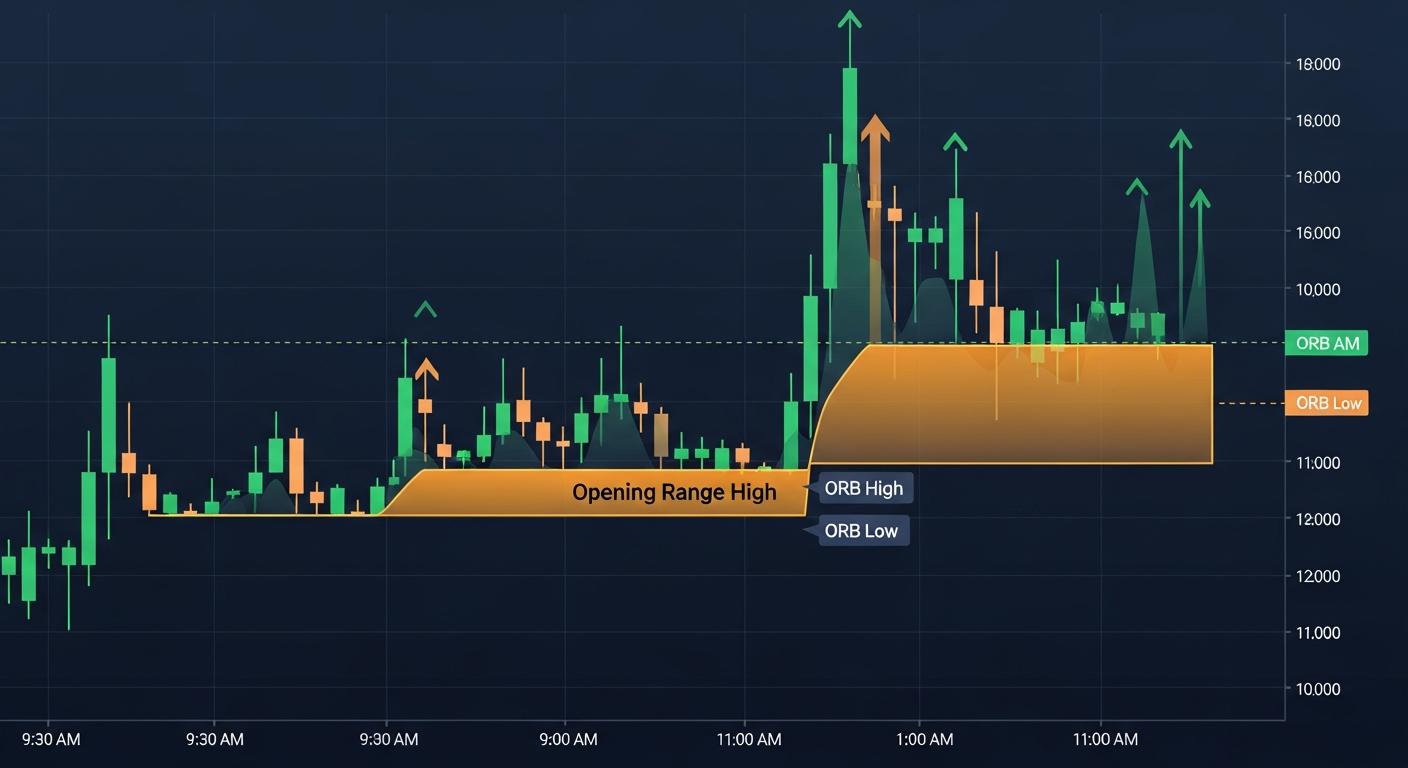
The opening range breakout strategy defines the high and low price of a stock or index during the first portion of the trading day — typically the first 15, 30, or 60 minutes — and then takes a directional trade when price breaks out of that range.
The idea is that the opening session is full of noise: orders from overnight holders clearing, pre-market news reacting, institutions adjusting positions. Once that initial chaos settles, a sustained break above the opening high or below the opening low often signals genuine momentum for the rest of the session.
With stocks, ORB traders buy shares or futures on the breakout. With options, you buy a call when price breaks above the opening range high, or a put when price breaks below the opening range low.
Why 0DTE Options and ORB Are a Natural Fit
Zero days to expiration (0DTE) options expire the same day they're traded. That makes them highly sensitive to intraday price movement — a strong directional move of just 1–2% can produce a 100–300% return on a well-positioned 0DTE call or put.
The ORB strategy is directional by design. You wait for the market to commit to a direction, then get in with a 0DTE option that profits if the momentum continues. The time constraint actually helps here: you're not holding overnight risk, and the 0DTE option will expire worthless if your directional read is wrong — which caps your max loss to the premium paid.
Popular underlying instruments for 0DTE ORB include:
- SPX / SPXW — the S&P 500 index, the most liquid options market in the world
- SPY — S&P 500 ETF, lower cost per contract than SPX
- QQQ — Nasdaq-100 ETF, higher beta and larger intraday moves
- NDX — the Nasdaq-100 index, similar to SPX but tech-heavy
Most ORB traders focus on SPX or SPY because the options liquidity is deep, the spreads are tight, and the market moves predictably around economic data releases and technical levels.
How to Define the Opening Range
The opening range is the high and low price during your chosen observation window. The most common windows are:
15-minute ORB: Captures the very early action. More breakouts trigger, but more false ones too. Works well in high-volatility environments.
30-minute ORB: The most popular window. Gives the market enough time to absorb morning news, but still leaves plenty of the session for momentum to play out.
60-minute ORB: The most conservative. Fewer signals, but stronger signal quality. The trade window is shorter, so you need faster moves.
For 0DTE options trading, 15-minute and 30-minute ORBs are most common because they leave 5–6+ hours for the trade to develop. A 60-minute ORB only gives you 5 hours, which is fine — but if you're targeting larger intraday moves, earlier entries tend to perform better.
How the Trade Works Step by Step
Here's the basic logic of a 30-minute ORB options trade on SPY:
- Market opens at 9:30 AM ET. You observe but don't trade.
- At 10:00 AM ET, you lock in the opening range: the high and low of the first 30 minutes.
- If SPY closes a candle above the ORB high, you buy a call — typically at-the-money or one strike out-of-the-money, expiring that same day.
- If SPY closes a candle below the ORB low, you buy a put — same parameters.
- You manage the position with a predefined stop-loss (e.g., 50% of premium) and a profit target (e.g., 100–150% gain), or you hold to a specific time like 2:30 PM ET.
The key discipline: you only take one signal per day. If the first candle after the observation window breaks up, you're in a call. If it breaks down, you're in a put. If neither breaks cleanly, you sit out and try again tomorrow.
Adding Filters to Reduce False Breakouts
Not every ORB signal is worth taking. Experienced traders add filters to improve the hit rate:
VIX filter: If the VIX (CBOE Volatility Index) is above a certain level — say, 30 or 35 — the market is in a stress regime where ORB signals tend to be noisy. A bot can check the VIX at the start of the day and skip trading if conditions are too volatile.
Volume confirmation: A breakout on low volume is often a head-fake. Requiring the breakout candle to have above-average volume improves signal quality.
Gap filter: If SPY gaps up or down more than 1% at the open, the opening range is often distorted. Some traders skip ORB on large gap days.
Time filter: Skip ORB trades on FOMC announcement days, major economic data releases (CPI, jobs report), or option expiration Fridays when behavior tends to be unusual.
These filters are easy to hard-code into an automated bot — which is exactly where automation gives you an edge over manual trading.
Why Automate the ORB Strategy?
The ORB strategy has one significant weakness when traded manually: the execution moment is stressful. You're watching charts, waiting for a breakout, and then suddenly you have to make a decision in seconds — what strike, what expiration, market or limit order, what size.
Most manual ORB traders miss entries, second-guess themselves, or size too small because they're not confident. Automation eliminates all of that.
A properly configured ORB bot:
- Monitors the opening range automatically — no chart watching required
- Detects the breakout in real time and executes the order at the correct strike and expiration
- Applies your filters (VIX level, volume, gap size) before entering
- Manages the position — stops and targets run automatically
- Keeps a log of every trade for review and improvement
You go from watching charts for 45 minutes every morning to reviewing a trade summary over coffee. That's the real value of automation for a strategy like ORB.
Building an ORB Bot on OptionBots
OptionBots is built for exactly this kind of strategy. The platform lets you configure the opening range window, define your breakout conditions, specify which options to buy (delta, expiration, strike selection), and set your risk management rules — all without writing code.
You connect your brokerage account (Tastytrade, Tradier, TradeStation, Public, and others are supported), and the bot handles execution from signal detection through position management.
To get started with ORB automation on OptionBots:
- Sign up and connect your broker — or start with paper trading to test without real capital
- Navigate to the Opening Range Breakout strategy template in the strategy library
- Configure your observation window (15, 30, or 60 minutes)
- Set your breakout conditions and any filters you want (VIX, volume, gap)
- Define your risk management — max loss per trade, profit target, exit time
- Run in paper trading mode for a few weeks to evaluate performance before going live
The paper trading environment uses real-time market data, so your results reflect what would have actually happened — not hypothetical prices. Once you're comfortable with the strategy's behavior, switching to live execution is one toggle.
Frequently Asked Questions
What's the best underlying for 0DTE ORB options?
SPX and SPY are the most popular for 0DTE ORB because of their liquidity. QQQ is also used frequently, especially by traders who prefer higher-beta moves. Avoid thinly traded stocks — wide spreads on 0DTE options will eat into profitability fast.
How much capital do I need to trade ORB options?
SPY 0DTE options typically cost $50–$500 per contract depending on strike and market conditions. You don't need a large account, but you should size positions so that your max loss (premium at risk) is no more than 1–2% of your total account per trade.
Is the ORB strategy profitable?
No strategy wins every day. The ORB strategy's edge comes from capturing outsized moves on the days it works, while keeping losses capped to the premium paid on the days it doesn't. Win rate tends to be lower than 50%, but average winners are larger than average losers — classic asymmetric payoff structure.
What time should I enter after the opening range?
Most ORB traders enter on the first candle close after the observation window ends. For a 30-minute ORB, that's the 10:00 AM candle close. Waiting for a candle close (rather than intrabar highs) reduces false signals.
Can the ORB strategy be fully automated?
Yes — the ORB is one of the most automation-friendly options strategies that exists because it's entirely rules-based. Every decision point (observation window, breakout condition, strike selection, stop-loss, take-profit) can be defined in advance and executed by a bot without human input.
Run a Hedge Fund From Your Bedroom
Finally have an excuse to call yourself a quant trader. Because that's what you'll be.

A visual bot-building platform for 0DTE options traders. Build,
backtest, and automate your trading strategies without coding.
Please read FINRA's notice on auto-trading services here.
Options trading is not suitable for all investors due to its inherent high risk, which can potentially result in significant losses. Please read Characteristics and Risks of Standardized Options before investing in options.
Contact: support@optionbots.com
Address: 275 SW 6th St, Miami, FL 33130
This site is not part of Facebook, Inc. It is not endorsed by Facebook in any way. FACEBOOK is a trademark of FACEBOOK, INC.