
Key Takeaways
- OptionBots is built specifically for no-code, visual credit spread and 0DTE bot construction with integrated backtesting.
- Option Alpha is free for traders willing to route orders through Tradier — covers entries, exits, and rolls.
- TradeSteward focuses on managing open spreads (rolls, adjustments, defense) rather than sourcing new entries; Tastytrade only.
- TradersPost and SignalStack are execution bridges — they need a working TradingView alert before they do anything.
- Tastytrade's native tools are semi-automated: alerts fire, but you still have to act on them manually.
- Interactive Brokers TWS API gives full control with no subscription fee, but requires real programming ability.
Credit spreads reward consistency and punish inattention — a defined-risk trade that goes unmanaged through 21 DTE or a delta breach can turn a small planned loss into a max loss. The best options trading bots for credit spreads in 2026 are OptionBots, Option Alpha, TradeSteward, TradersPost, and SignalStack, each automating a different piece of the entry-management-exit cycle. This guide compares all seven — including two broker-native paths worth knowing about before you pay for a third-party tool — by broker compatibility, automation depth, and cost.
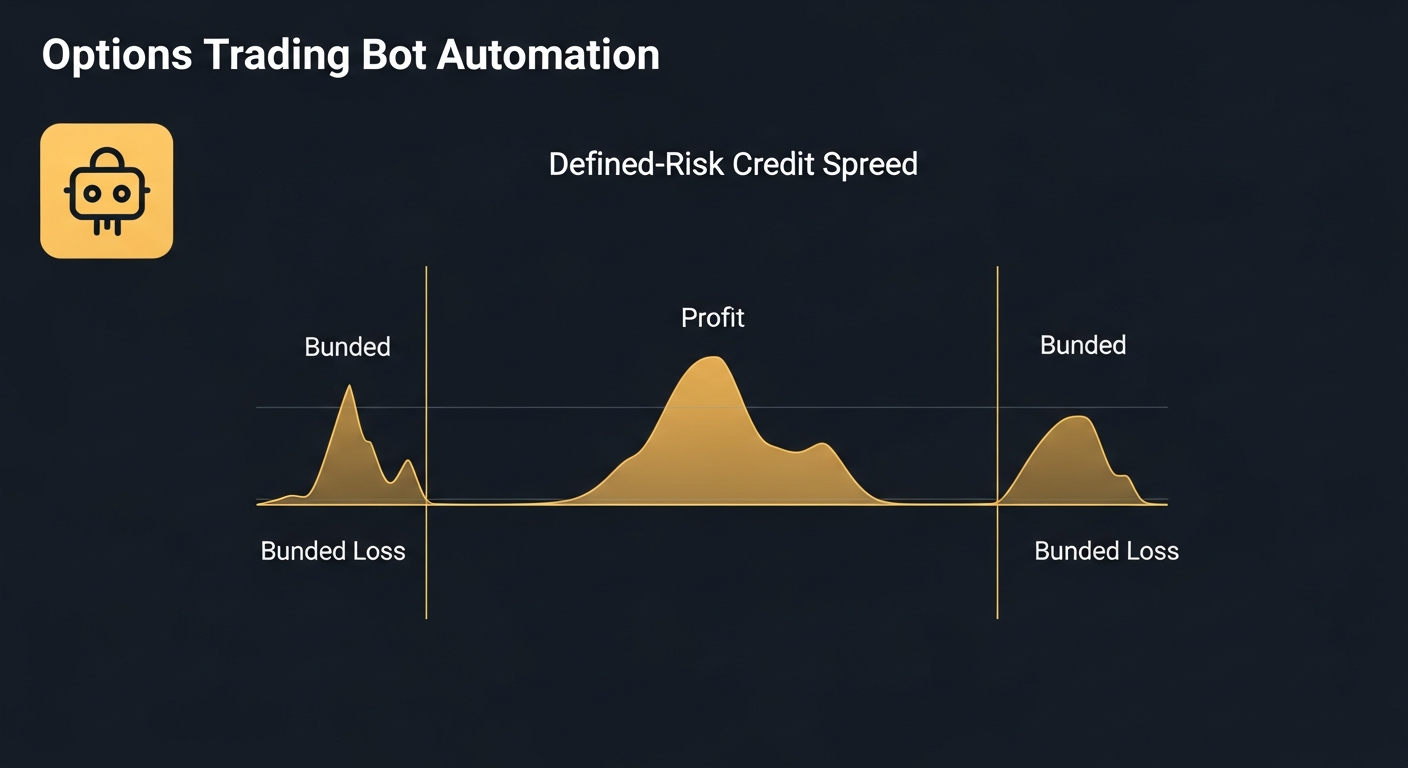
Credit spreads (bull put spreads, bear call spreads, iron condors) are a defined-risk way to collect premium, but the edge lives in the management rules — rolling untested sides at 21 DTE, closing at 50% max profit, defending or cutting losses at a set multiple of credit received. Doing that by hand across multiple positions is where most retail traders leak returns.
Quick Answer
- OptionBots — Best for: traders who want a visual, no-code bot builder purpose-built for defined-risk 0DTE and swing credit spreads with integrated backtesting.
- Option Alpha — Best for: traders who want a free, no-code automation platform for credit spreads and iron condors, as long as they route orders through Tradier.
- TradeSteward — Best for: Tastytrade users who want automated position defense (rolling, adjusting, stop-losses) on complex multi-leg spreads without managing them manually.
- TradersPost — Best for: traders already generating entry signals in TradingView or TrendSpider who want those alerts converted into live credit spread orders across brokers.
- SignalStack — Best for: traders who want a lightweight webhook bridge that routes TradingView alerts straight to broker execution with minimal setup.
- Tastytrade native tools — Best for: traders who want built-in alerts and one-click adjustments without paying for or connecting a third-party bot.
- Interactive Brokers TWS API — Best for: programmers who want full control over spread logic, position sizing, and risk rules with no subscription fee beyond IBKR itself.
Methodology
Every entry was evaluated against five criteria that matter specifically for credit spread automation: broker compatibility, spread-specific automation depth (entries only, or also rolls and closes), risk controls (stop-loss logic, delta-based defense, position sizing), ease of setup, and pricing relative to what's automated.
Sources consulted include each platform's official documentation and pricing pages, Tastytrade's and Interactive Brokers' broker API documentation, and community discussion on r/options and r/thetagang. No performance claims, win rates, or return figures are cited — none were independently verifiable.
Author: OptionBots Editorial Team • Last updated: July 15, 2026
Comparison Table
| Tool | Best For | Strength | Limit | Pricing |
|---|---|---|---|---|
| OptionBots | No-code 0DTE and swing credit spread bots with backtesting | Visual bot builder, built-in backtesting engine, direct broker integrations | Newer platform; templates focus on defined-risk and 0DTE structures | Paid plans; free paper trading included |
| Option Alpha | Free no-code credit spread automation | Genuinely free core platform, mature rule-chain builder for entries and exits | Requires Tradier as the connected broker | Free |
| TradeSteward | Automated defense on complex multi-leg spreads | Strong rolling/adjustment logic for iron condors and spreads, built for Tastytrade | Tastytrade-only; not broker-agnostic | Paid subscription tiers |
| TradersPost | Converting TradingView signals into live spread orders | Broad broker support (Tastytrade, Tradovate, Alpaca, TradeStation, IBKR) | Requires a working signal source — execution bridge, not a strategy generator | Paid subscription tiers |
| SignalStack | Lightweight webhook-to-broker execution | Simple setup, low overhead for routing TradingView alerts | Same dependency as TradersPost — you need working alerts first | Paid subscription tiers |
| Tastytrade native tools | Built-in alerts and manual one-click adjustments | No extra cost, tightly integrated with Tastytrade | Not true automation — you still act on alerts manually | Included with a Tastytrade account |
| Interactive Brokers TWS API | Fully custom-coded spread logic | Total control over entries, sizing, and risk rules; institutional-grade API | Requires programming ability and ongoing code maintenance | Included with IBKR account (commissions apply) |
OptionBots
Best for: Traders who want a no-code, visual way to build and backtest credit spread and iron condor bots, particularly for 0DTE and short-dated structures.
Features: Drag-and-drop bot builder for constructing entry and exit rules around delta targets, DTE windows, and IV filters. A backtesting engine tests spread logic against historical data before going live. Direct broker integrations execute bots without manual order entry. Paper trading with roughly $500,000 in simulated capital lets you validate strategy rules risk-free.
Limits: Newer than platforms like Option Alpha, so smaller community footprint. Templates lean toward defined-risk and 0DTE structures — a feature for credit spread traders specifically, but a limit if you want a general-purpose options platform.
Pricing: Paid subscription plans with free paper trading to test before subscribing. See optionbots.com/pricing.
Choose if: You want to build and backtest credit spread rules visually without writing code, and you specifically trade short-dated defined-risk structures like iron condors and credit spreads.
Option Alpha
Best for: Traders who want free, no-code automation for credit spreads and are willing to trade through Tradier.
Features: A mature rule-chain builder that lets you define entry conditions (delta, DTE, IV rank), automate exits (profit targets, time-based closes), and layer in logic for rolls or cooldown periods. Large library of prebuilt bot templates and educational content.
Limits: Requires Tradier as your connected broker. If you already trade through Schwab, Tastytrade, or Interactive Brokers and don't want to open a separate Tradier account, this is a hard constraint.
Pricing: Free for the core automation platform.
Choose if: Cost is your primary constraint and you're willing to route your credit spread execution through Tradier.
TradeSteward
Best for: Tastytrade users who want automated position defense — rolling, adjusting, and stop-losses — on multi-leg spreads without manual monitoring.
Features: Rule-based automation focused on managing open positions: automated rolling of untested sides, delta-based adjustments, predefined stop-loss and profit-target triggers. See also: best options bots for Tastytrade.
Limits: Connects to Tastytrade only. Moving to a different broker is required to use this tool elsewhere.
Pricing: Paid subscription, tiered by account size and feature access.
Choose if: You already trade on Tastytrade and your main pain point is the ongoing management of open spreads — rolling, defending, closing — rather than finding new entries.
TradersPost
Best for: Traders who already generate entry signals in TradingView or TrendSpider and want those converted into live credit spread orders.
Features: Broad broker connectivity including Tastytrade, Tradovate, Alpaca, TradeStation, and Interactive Brokers. Supports stocks, options, futures, and crypto — one subscription covers multiple asset classes.
Limits: An execution bridge, not a strategy generator. You need a working TradingView or TrendSpider alert setup before this tool does anything useful.
Pricing: Paid subscription tiers based on trading volume and broker connections.
Choose if: You've already built a signal strategy in TradingView and need a reliable way to turn those alerts into real broker orders.
SignalStack
Best for: Traders who want the simplest possible webhook bridge from TradingView alerts to broker execution.
Features: Lightweight setup focused on one job — routing TradingView webhook alerts to your broker as live orders — with lower overhead than broader platforms like TradersPost.
Limits: Same core dependency as TradersPost: you need functioning alerts before SignalStack has anything to execute. Not a strategy builder or backtesting tool.
Pricing: Paid subscription tiers, generally lower-cost than broader execution-bridge platforms.
Choose if: You want the minimum viable setup to get TradingView alerts executing as credit spread orders and don't need broader broker coverage.
Tastytrade's Native Platform Tools
Best for: Traders who want built-in alerts and quick manual adjustments without paying for any third-party bot.
Features: Price and P/L alerts, one-click roll and close tools, and position monitoring dashboards built directly into Tastytrade — no external subscription or API connection required.
Limits: Not true automation. You still have to see the alert and act on it yourself — it doesn't solve the core problem of needing to be at your screen.
Pricing: Included with a Tastytrade brokerage account.
Choose if: You trade a small number of positions and manual, alert-assisted management is enough.
Interactive Brokers TWS API (Custom-Coded)
Best for: Traders with programming experience who want complete control over credit spread logic, sizing, and risk rules.
Features: Institutional-grade market access across 150+ markets in 33 countries. No subscription fee beyond your IBKR account — build exactly the entry, adjustment, and exit logic you want in Python or another supported language.
Limits: Requires real programming ability and ongoing code maintenance. No visual builder, no prebuilt templates, no vendor support for your strategy logic.
Pricing: Included with an Interactive Brokers account; standard IBKR commissions and data fees apply.
Choose if: You can code, want zero platform lock-in beyond your broker, and are willing to build and maintain your own automation.
Decision Framework
Choose OptionBots if you want a no-code visual builder specifically suited to defined-risk and 0DTE credit spread structures, with backtesting built in before you go live.
Choose Option Alpha if budget is the deciding factor and you're comfortable trading through Tradier to get free automation.
Choose TradeSteward if you're already on Tastytrade and your real problem is managing open spreads — rolls, adjustments, defense — not finding new entries.
Choose TradersPost or SignalStack if you already have a working TradingView signal strategy and need it converted into live orders; pick TradersPost for broader broker/asset coverage, SignalStack for a simpler, lower-cost bridge.
Choose Tastytrade's native tools if you trade a handful of positions and manual, alert-assisted management is enough.
Choose Interactive Brokers' TWS API if you can code and want total control with no subscription layered on top of your broker.
Avoid any of these if you're not yet comfortable with the mechanics of credit spreads themselves. Automating a strategy you don't understand just lets you lose money faster. Related: How to Automate the Wheel Strategy.
OptionBots provides software tools for automating options-trading strategies. This is not financial, investment, or trading advice. Options trading involves significant risk and is not suitable for all investors.
Frequently Asked Questions
Do I need to code to automate credit spreads?
No. OptionBots and Option Alpha both offer no-code, visual rule builders for credit spread entries and exits. Coding is only required if you go the custom TWS API route on Interactive Brokers.
Which broker works with the most credit spread automation tools?
Tastytrade has the broadest third-party tool support among options-specific platforms on this list. Interactive Brokers supports the most tools overall once you include general-purpose platforms, largely because of its institutional-grade API.
Can these bots roll or adjust credit spreads automatically, or just enter trades?
It depends on the tool. TradeSteward and Option Alpha both support rule-based rolling and adjustment logic in addition to entries. TradersPost and SignalStack are primarily execution bridges — they act on signals you generate elsewhere and don't include native rolling logic.
Is free automation with Option Alpha actually as capable as paid tools?
For traders willing to route trades through Tradier, Option Alpha's no-code rule-chain builder covers entries, exits, and rolls comparably to paid alternatives. The tradeoff is broker lock-in, not feature depth.
What's the difference between a signal bridge like TradersPost and a full bot builder like OptionBots?
A signal bridge (TradersPost, SignalStack) executes trades based on alerts you generate somewhere else, typically TradingView. A full bot builder (OptionBots, Option Alpha) lets you define the entry and exit logic itself inside the platform, with no external signal source required.
Run a Hedge Fund From Your Bedroom
Finally have an excuse to call yourself a quant trader. Because that's what you'll be.

A visual bot-building platform for 0DTE options traders. Build,
backtest, and automate your trading strategies without coding.
Please read FINRA's notice on auto-trading services here.
Options trading is not suitable for all investors due to its inherent high risk, which can potentially result in significant losses. Please read Characteristics and Risks of Standardized Options before investing in options.
Contact: support@optionbots.com
Address: 275 SW 6th St, Miami, FL 33130
This site is not part of Facebook, Inc. It is not endorsed by Facebook in any way. FACEBOOK is a trademark of FACEBOOK, INC.